Cooking Class with a Local Balinese Family — The Real Ubud Experience
A Balinese cooking class in a local family's compound — not a tourist venue. Cook with a Balinese chef over charcoal, learn the stories behind the dishes, and eat together among the rice fields.
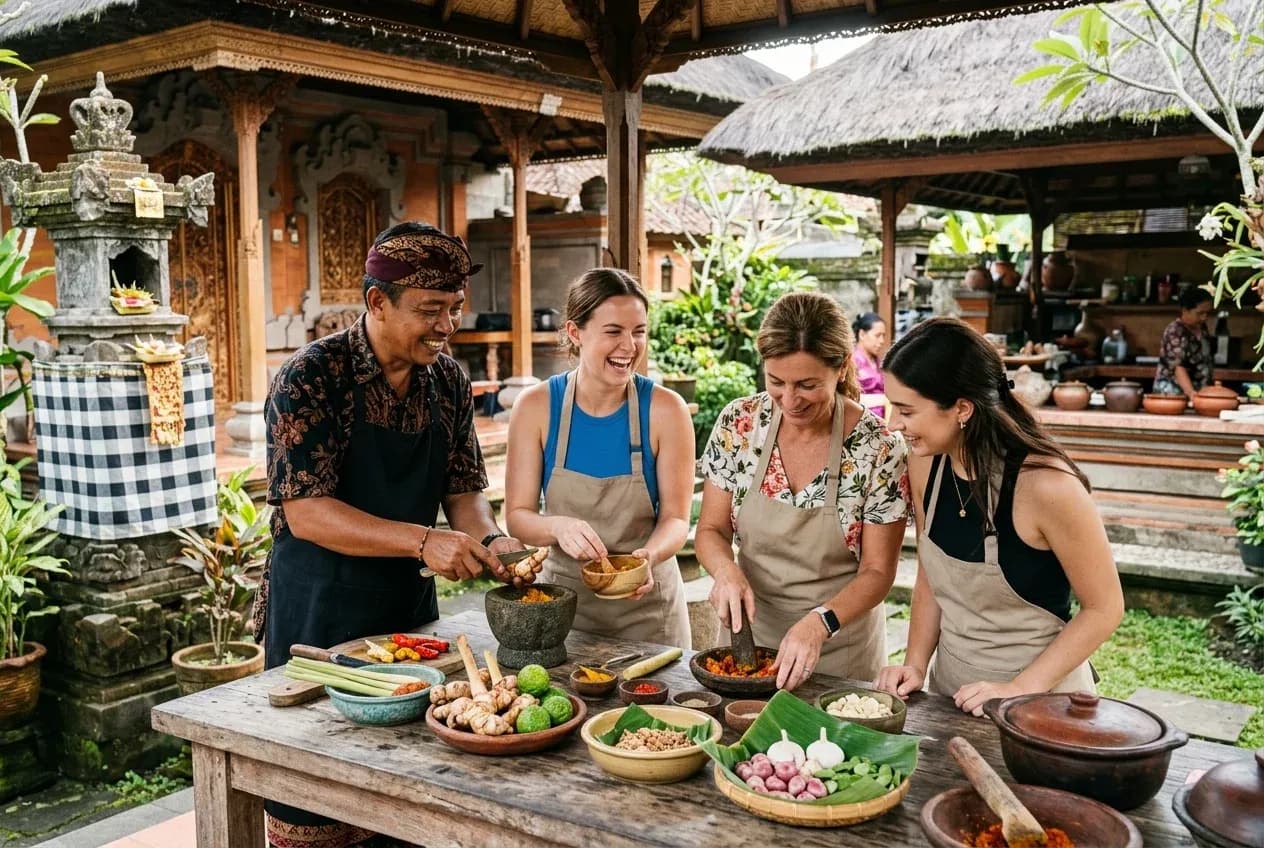
Cook with a local family, not a tour group.
The difference between a tourist cooking class and a cultural cooking experience in Bali comes down to one thing: who's teaching you. At Tumang, you're not in a restaurant kitchen or a hotel function room. You're in a family compound just outside Ubud, cooking alongside a local Balinese chef who grew up making these dishes.
1. A home, not a venue
Our kitchen is part of a family compound — your guide may even be the home's resident chef or the daughter of the family that runs it. The space is open-air, surrounded by banana trees, citrus plants, and chilies growing in pots. It's where meals for the family are made every day, not just for visitors.
There's no script, no rehearsed tour. Your guide shares personal stories — why turmeric is used in Balinese ceremonies, how the spice paste changes depending on which village you're from, what dishes their grandmother made that have been passed down through generations.
2. Cooking the way Balinese families cook
In a Balinese home, food preparation is a communal, social act. Everyone has a role: one person grinds the spice paste, another prepares the vegetables, another tends the fire. That's how we run the class — you're working alongside your guide, not watching a demonstration.
You'll learn the traditional Balinese spice making the way it's done by hand — using a cobek (stone mortar) and ulekan (pestle). A food processor can approximate it, but it doesn't bruise the herbs the same way, and the flavour is noticeably different. This is the part you'll take home with you — the muscle memory of grinding paste that no recipe book can give you.
3. The dishes have context
Every dish you cook has a story. Sate lilit isn't just satay — it's what you make when you're grilling at a temple festival and need something that cooks fast over coconut-husk charcoal. Urab is often served at celebrations. Bubur injin (black rice pudding) is the dessert that closes every good meal.
When you go back to your hotel and order from room service — or better yet, try to recreate these dishes at home — you'll understand not just the recipe but the context. That's the difference between a traditional Balinese cooking class and a tourist demonstration.
4. Eating as a family does
In Bali, meals are shared. Everyone eats from the same spread — no individual plates unless it's a Western-style setup. At our class, you eat together on banana leaves, just like a Balinese family would. You pass dishes around, you serve each other, you sit on the floor.
It might feel unfamiliar at first. It shouldn't. That's the point — this is a cultural cooking experience in the truest sense. You're not observing Balinese food culture; you're participating in it for an afternoon.
Frequently Asked Questions
Q: Is the cooking class really with a local family, or is it a business?
It's a family-run operation. Our chef guides have worked with us for years — some for a decade or more — and they grew up cooking these dishes in Balinese homes. This is their livelihood and their heritage.
Q: What makes this an authentic Balinese cooking experience?
The setting, the ingredients, and the method. We source from the morning market, we cook outdoors on charcoal, we use a stone mortar for the spice paste, and we eat communally on banana leaves. None of that is optional — it's how Balinese families actually cook.
Q: Can I ask my guide personal questions about Balinese culture?
Absolutely. We encourage it. Your guide will be happy to talk about Balinese daily life, food taboos, ceremony, and traditions. Most guests say the conversation was one of the highlights of the class.
Q: Do I need to be comfortable with strangers to do this?
Not at all. Balinese people are famously warm and welcoming. Your guide will make you feel at home — literally. Whether you're travelling solo, as a couple, or with a group, everyone sits down together and shares the meal.
This is how food is meant to be shared.
A class led by a local Balinese chef in a family compound, surrounded by rice fields. Book your spot — mornings include the market tour.