How a Balinese Cooking Class Works — Full Walkthrough (2026)
Step by step: what happens during a traditional Balinese cooking class in Ubud, from pickup to the final dessert. How long it takes, what you cook, what to expect, and what to wear.
How a Balinese cooking class works, step by step.
You've seen the photos — people grinding spices, grilling satay, eating over rice fields. But what does a traditional Balinese cooking class actually involve from start to finish? Here's a detailed walkthrough so you know exactly what to expect before you book.
Step 1: Hotel pickup (8:00 AM — morning class)
We pick you up from your hotel in the Ubud area. The pickup is free for the Ubud area — if you're staying further out (Sanur, Seminyak, Nusa Dua), message us and we'll arrange a shuttle. The van is air-conditioned and comfortable; the drive to the market takes 15–30 minutes depending on your location.
If you've searched for cooking class with hotel pickup Ubud or Bali cooking class with driver, rest easy — this is included at no extra cost. You don't need to figure out transport yourself. Just give us your hotel address when you book.
Step 2: The morning market tour (8:30–9:15 AM)
The market tour is only on the morning class because Ubud's working markets wind down before noon. Vendors start dismantling their stalls around 11 AM, so the afternoon slot skips this entirely.
At the market, your guide walks you through everything you'll need for the cooking class. You'll see and touch ingredients most visitors have never encountered: fresh turmeric roots (bright orange underneath), galangal (smells like pine and citrus), candlenut (a thickening agent), petai (stink beans — try one if you're brave), and snake fruit (salak), a sweet local fruit that grows in clusters.
This part is often what people mean when they ask about a Bali culinary tour and cooking class. It's not just a cooking lesson — it's a tour of the ingredients that make Balinese food distinctive.
Step 3: Rice field walk (9:15–9:30 AM)
After the market, we walk through the rice terraces to the cooking area. This is the rice paddy walk with cooking class experience — 15 minutes through the green, past farmers tending their fields, past water buffaloes wallowing in the mud.
Not every cooking class includes this. The ones that do are in the outskirts of Ubud, away from the main roads. That's the advantage of the setting — you're already surrounded by the landscape that defines Ubud before you even start cooking.
Step 4: Grinding the spice paste (9:30–10:30 AM)
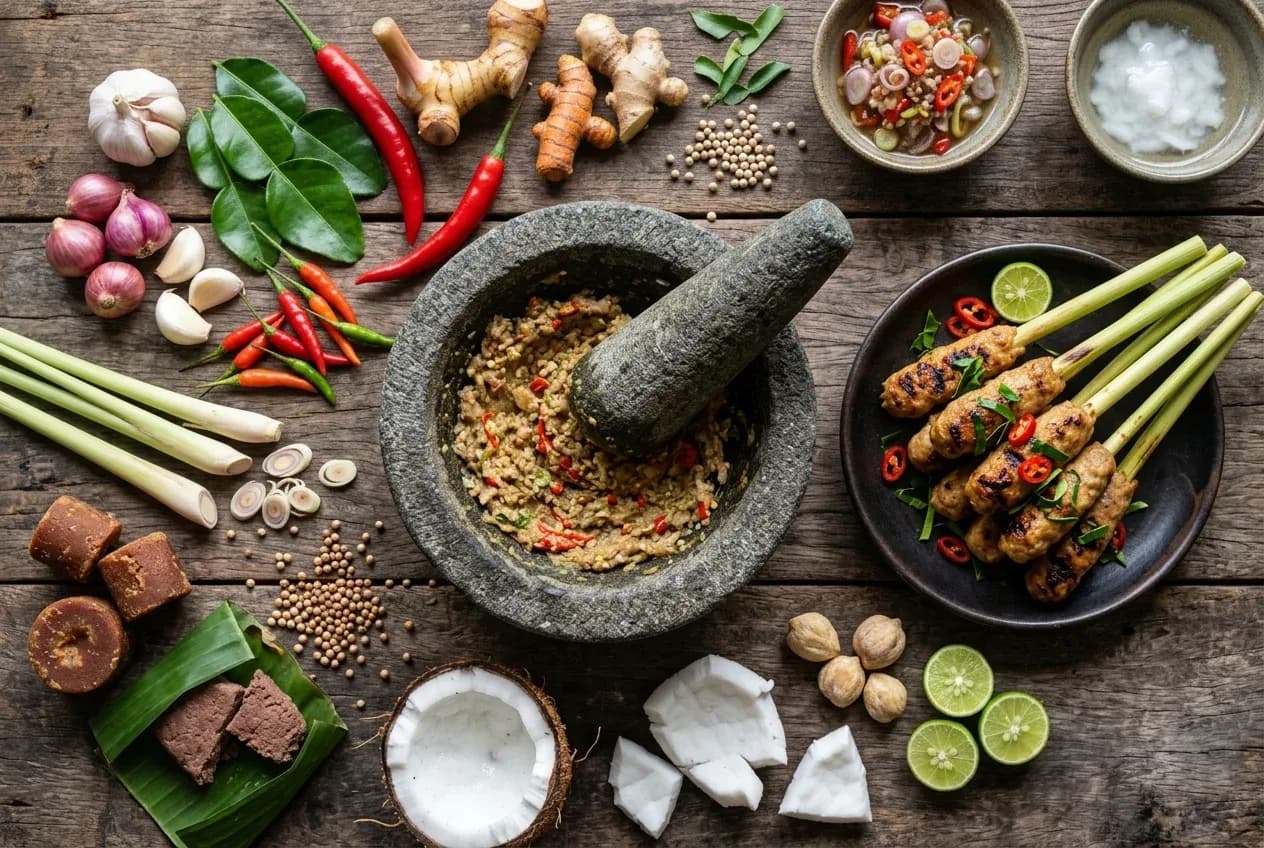
This is the heart of the class. You'll sit at a long table with your guide and a stone mortar (cobek) and pestle (ulekan). Together, you'll grind the base genep — the foundational Balinese spice paste that's used in almost every savoury dish on the menu.
The paste includes shallots, garlic, turmeric, galangal, ginger, lemongrass, candlenut, coriander, black pepper, shrimp paste (or omit for vegan), and palm sugar. Grinding it by hand takes about 20 minutes — it's physical, rhythmic work, and most guests find it unexpectedly satisfying. A food processor can do it in 30 seconds, but the flavour won't be the same. The stone bruises the fibres and releases oils that blending crushes instead.
If you're curious about traditional Balinese spice making or how to make Balinese food at home, this is where the real learning happens. We'll give you a written recipe to take home too.
Step 5: Cooking the dishes (10:30 AM–12:30 PM)
Once the paste is ready, the cooking moves to the charcoal grills and clay pots. Each station has a guide, so you get personal attention. You'll make:
Base Genep — the spice paste (finished) · Sate Lilit — minced satay on lemongrass · Chicken or Tofu Curry — in coconut sauce · Urab — coconut vegetable salad · Sambal Matah — raw shallot sambal · Sambal Goreng — cooked red chili paste · Nasi Pepes — fish or tofu steamed in banana leaf · Nasi Goreng — fried rice · Bubur Injin — black rice pudding (dessert)
That's 10–12 dishes total, all cooked by you. Some are hands-on (the satay, the curry), some are guided (the sambals, the pepes), and some are already simmering when you arrive.
This is what people mean when they ask what do you cook in a Bali class — it's a full menu, not a single dish.
Step 6: The feast (12:30–1:30 PM)
Everyone sits down together. The food goes onto banana leaves on a long table in the shade. You eat what you've cooked — most of it, at least. Some dishes (like the curry) take longer, so your guide starts those while you're working on others.
You'll spend about an hour eating, talking, and enjoying the rice field views. There's no rush. After the meal, you can stay longer if you like — many guests just sit and soak in the atmosphere. The rice fields don't get old.
Step 7: Recipe book and goodbye
Before you go, you'll receive a take-home recipe book with all the dishes from the class written down in English. Most guests say this is the best souvenir they bring back from Bali — because it's not a trinket, it's something they'll actually use.
Your guide may even share personal recipes that aren't in the book. The market-tour morning class typically ends around 1 PM, and we drive you back to your hotel.
Frequently Asked Questions
Q: How long is a Balinese cooking class?
The morning class (with market tour) takes about 5 hours from pickup to drop-off. The afternoon class is about 3 hours.
Q: What time does the class start?
Morning class starts at 8:00 AM (pickup). Afternoon class at 2:00 PM.
Q: What should I wear to a cooking class in Bali?
Comfortable, casual clothes. You'll be sitting cross-legged on the ground at times, so avoid very tight or restrictive clothing. Bring a hat and sunscreen for the market walk. Closed-toe shoes are fine, but the path is flat and well-maintained.
Q: What's included in a Balinese cooking class?
Everything: hotel pickup and drop-off, the market tour (morning class), rice field walk, all ingredients, a full lunch/dinner of what you cook, a take-home recipe book, and beverages during the class. See our pricing page for full details.
Q: Is the class suitable for beginners?
Yes — it's designed for complete beginners. Most of our guests have never cooked Balinese food before. Your guide walks you through every step, and it's as much about culture and fun as it is about cooking.
Q: What if I have dietary restrictions?
We accommodate vegetarians, vegans, and most allergies. Just let us know when you book and we'll adjust the menu. Every dish has a vegan version.
Q: Can I do a cooking class if I'm not staying in Ubud?
Yes — we can arrange pickup from other parts of Bali for an additional transport fee. The class itself happens in the Ubud area, surrounded by rice fields.
Everything you need to know, before you book.
Morning class with market tour (5 hours) or afternoon class focused on cooking (3 hours). Free Ubud pickup, vegetarian options, beginner-friendly.